 Episode 12
· 11:47
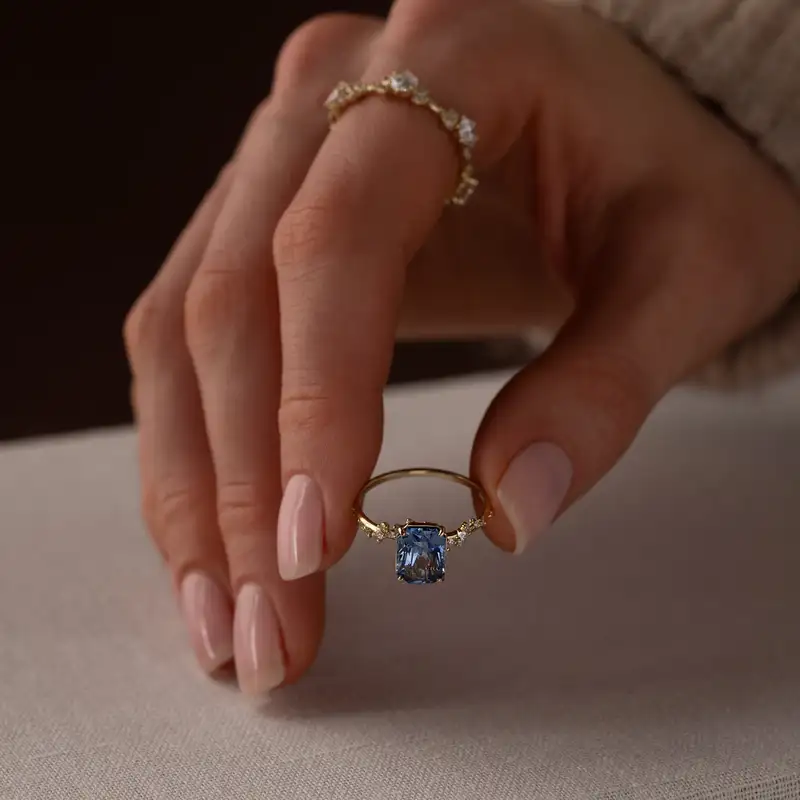
Melanie Casey: Welcome back to The Engagement Ring Podcast. I'm Melanie Casey, founder of the fine jewelry brand Melanie Casey Jewelry, and today we're discussing the sapphire engagement ring. If you're considering a sapphire engagement ring, stay tuned. We'll discuss the range of sapphire colors, how they compare to diamonds, how to properly care for your sapphire ring, and finally, my two cents on wedding band pairings.
Melanie Casey: After diamond, sapphire is our most requested stone. Most people know of sapphire in its most common dark blue form, but it actually comes in a full rainbow of colors. Yes, traditional dark blue sapphire is iconic, but most of our sapphire clients are looking for a stone that is completely unique.
Melanie Casey: Right now, in 2026, we're sourcing a lot of teal, sky blue, peach, plum, all of the range of greens, and bicolor. Bicolor is when a sapphire has two distinct colors showing in one stone, like blue and yellow or blue and green.
Melanie Casey: Yellow and white sapphires used to be very popular for us, but with the invention of lab-grown diamonds in recent years, we've found that yellow and white sapphires are very rarely requested these days.
Melanie Casey: If you're considering a sapphire engagement ring, your first step is to decide what color speaks to you. When our clients have their hearts set on a specific color, we find it best if they're flexible on the shape of the stone.
Melanie Casey: We always maintain extremely high clarity standards, so if you're working with our team, you never have to make a decision about quality. Luckily, that's one less decision to make.
Melanie Casey: But your flexibility on something like shape allows us to get as close to your favorite color as we possibly can.
Melanie Casey: I source sapphires from across the world, with each region having its own specialty. I find myself sourcing from the mines of Montana here in the USA most often.
Melanie Casey: Montana sapphires range in color, but often have that muted or pale tone, or an oceanic teal range that's really hard to find elsewhere.
Melanie Casey: The Montana mines also produce some of the most incredible two-toned bicolor sapphires on Earth. When a client is looking for a strong, saturated, colorful sapphire, then I'll look to Australia or East Africa.
Melanie Casey: And for a deep, rich, cornflower blue sapphire, I love the Sri Lankan mines.
Melanie Casey: My advice is to choose your ideal color, set a size range that you're interested in, and provide a few of your favorite stone shapes.
Melanie Casey: Then, let the artist you're working with source from the region that makes the most sense.
Melanie Casey: Many of our clients come to us unsure whether they want a sapphire or a diamond. Each has its benefits.
Melanie Casey: First, both stones are exceptionally durable. Sapphire has a Mohs hardness of 9 out of 10, and as you'd expect, diamond ranks the very top, with a hardness of 10.
Melanie Casey: Durability will not help you decide between these two stone options. They're both excellent choices.
Melanie Casey: Truthfully, most clients who choose sapphire simply want a ring that is so unique that nobody else will have it, or anything like it.
Melanie Casey: That's actually my favorite reason to recommend sapphire for your focal stone.
Melanie Casey: A recent client of ours told us he was choosing sapphire partly for the unique color, but mostly for his partner's love of the luminous glow of a sapphire.
Melanie Casey: She preferred that sparkle. So for many, sparkle is the deciding factor.
Melanie Casey: Sapphire will sparkle more like candlelight, compared to a diamond that has stark white, sharp sparkle.
Melanie Casey: Diamond is like sunlight, whereas sapphire is more like moonlight.
Melanie Casey: This isn't always the case, as I have sourced many sapphires that have incredible fire.
Melanie Casey: But for the most part, sapphires are cut to enhance the color, and the faceting isn't as precise or as careful as you find in a diamond.
Melanie Casey: For those new to the search, this discussion wouldn't be helpful if we didn't at least touch on budget.
Melanie Casey: It should be noted that lab-grown diamonds have changed the engagement ring market dramatically in the last couple of years.
Melanie Casey: This is what I've personally observed in the last year in the engagement ring industry.
Melanie Casey: First, natural diamonds, especially fancy colored diamonds, are typically the most expensive option in the market.
Melanie Casey: Pricing, luckily, is pretty transparent with diamonds, and you can look up pricing to understand where your budget might fall based on the Rapaport price.
Melanie Casey: You can literally Google that.
Melanie Casey: There are, of course, nuances, but we're not getting into diamond prices today.
Melanie Casey: We're talking about sapphires.
Melanie Casey: Sapphires are typically a little less expensive than a natural diamond of equal size and quality.
Melanie Casey: But, of course, there are exceptions.
Melanie Casey: Rarity of color, high clarity, and larger carat sizes all impact the price point of a sapphire.
Melanie Casey: Sapphire is an expensive, rare natural gemstone. Each stone's uniqueness contributes to its price and explains why certain stones become collector stones.
Melanie Casey: The third option for most people choosing an engagement ring would be a lab-grown diamond.
Melanie Casey: And while lab-grown diamonds are by no means inexpensive, they're the best choice for somebody who really wants predictability in budget and ease of sourcing.
Melanie Casey: So, for instance, if you know you want a perfect IF clarity, D color, one-carat lab-grown diamond, we will never have trouble sourcing that for you anytime during the year.
Melanie Casey: They're beautiful, durable, and high quality, but lab-grown diamonds are not necessarily rare the way that sapphires are.
Melanie Casey: And sapphires just simply are significantly more difficult to source.
Melanie Casey: With budget as a consideration, this is what I recommend if you're on the fence.
Melanie Casey: I think quality is worth investing in when it's an engagement ring.
Melanie Casey: I would always choose a high quality sapphire over a low quality natural diamond of the same dollar value.
Melanie Casey: Similarly, if a client is considering a lower-quality sapphire due to budget constraints, at that point I would suggest they opt for a perfect-quality lab-grown diamond instead.
Melanie Casey: Basically, I recommend choosing a focal stone that fits your budget but also allows you to invest in an eye-clean stone with no black spots, haze, or milkiness—without making great sacrifices on the details you love most.
Melanie Casey: If you know you absolutely want color, there are options in sapphire and lab-grown diamond.
Melanie Casey: Let's talk about sapphire engagement ring care.
Melanie Casey: Even though sapphires are extremely durable, proper care is still important.
Melanie Casey: Just like with any fine jewelry, it's a good idea to remove your rings during certain activities.
Melanie Casey: A recent repair came in because our client hit her hand in her car door, smooshing her ring and chipping her stone.
Melanie Casey: We were able to smooth out the chip, and luckily it was relatively hidden once the stone was reset into a new setting. But just be careful.
Melanie Casey: You should not move furniture in your ring. You should really try not to catch your hand in a car door, if at all possible—but mostly for you, because it's awful.
Melanie Casey: The point is, you do need to take care of your jewelry, even when your focal stone is a strong stone like sapphire.
Melanie Casey: When you're cleaning, working out, sleeping, showering, or swimming, all of those things can impact your ring.
Melanie Casey: Chemicals like chlorine and bleach are enemies of your fine jewelry.
Melanie Casey: And yes, sapphires are durable, but if there is a small, invisible weakness in a natural stone, it could someday chip from repeated exposure to chemicals or from hitting it hard in your environment.
Melanie Casey: I highly recommend regular cleaning. When dirt and debris build up around a gemstone—or even a diamond—they can act like microscopic sandpaper.
Melanie Casey: The facets can actually wear down over the years, or the prongs can be worn away and weakened because of the grime and that rubbing effect.
Melanie Casey: That's why cleaning your ring regularly helps preserve both its sparkle and its long-term strength.
Melanie Casey: Use a small dot of dish soap to cut through the natural oils from your skin, and gently scrub your ring with a soft toothbrush. It's honestly just that simple.
Melanie Casey: For a deeper clean, many of our clients use the ultrasonic cleaner on our website, and we do recommend this method for sapphires.
Melanie Casey: With regular cleaning, your sapphire engagement ring will maintain its polish and finish, and your stone will stay protected.
Melanie Casey: Your wedding band decision is as important as choosing your engagement ring.
Melanie Casey: You'll wear them together for the rest of your life, so I recommend considering the entire set, not just focusing on your focal stone.
Melanie Casey: I almost always style our sapphire engagement rings with white diamond wedding bands.
Melanie Casey: I prefer the color to be in the focal stone, and let the white diamonds in the wedding band add dimension without overpowering.
Melanie Casey: If you choose a simple solitaire for your sapphire, then you have even more room to play with the level of statement of your wedding band.
Melanie Casey: If you don't want too much flash, a wide metal band might be for you.
Melanie Casey: Take a look at our Thick and Thin Collection for inspiration, and reach out to our customer service team to ask for photos and get your creativity flowing.
Melanie Casey: If you're really feeling torn on the right wedding band for you, we can send you photo examples.
Melanie Casey: We often have clients reach out, and we'll shoot photos of a few of their favorite wedding bands with the setting they plan to choose. It makes the entire process a lot easier.
Melanie Casey: From the deep blues to the soft pinks, the vibrant greens, and even stones with multiple colors inside, sapphires provide an incredible range of possibilities.
Melanie Casey: They're durable enough for everyday wear, full of character, and endlessly unique.
Melanie Casey: Whether you pair your sapphire stone with sparkling diamonds, a simple metal band, or anything else you can dream up, there are countless ways to create a wedding set that feels completely your own.
Melanie Casey: Thank you for joining me today. If you've enjoyed this deep dive into sapphire engagement rings, be sure to subscribe so you don't miss future episodes.
Melanie Casey: If you're currently exploring engagement ring options, sapphires might just be the perfect place to start.
Melanie Casey: Visit our website at MelanieCasey.com or visit our studio in Andover, Massachusetts during one of our Open Showroom events.
Melanie Casey: They're weekly and we would love to meet you and show you all the possibilities.
Listen to The Engagement Ring Podcast by Melanie Casey Jewelry using one of many popular podcasting apps or directories.